climateBR helps social scientists study climate shocks in Brazil. It provides tools to download, process, and analyze historical meteorological data from the Brazilian National Institute of Meteorology (INMET).
Installation
# From CRAN
install.packages("climateBR")

# Development version (latest features)
remotes::install_github("kaiorb52/climateBR")
Example: Maximum temperature in Rio de Janeiro state (2026)
First, download the historical INMET CSV files with download_inmet().
Next, convert the raw files into a partitioned Apache Arrow dataset with build_inmet_dataset(). This step is essential: each station’s CSV file has about 8,000 rows per year, and with more than 500 stations in Brazil, a single year can reach about 4 million observations. That is too much for most computers to handle efficiently as plain CSV files.
Finally, use read_inmet() to query the processed dataset.
library(climateBR)
library(dplyr)
data("mun_stations")

# The package includes datasets that speed up data aggregation.
# For example, `mun_stations` was created with `nearest_stations()` and links
# each of Brazil's 5,570 municipalities to its five nearest stations.

download_inmet(
  years = 2026,
  unzip_to = "data/raw/inmet"
)

build_inmet_dataset(
  input = "data/raw/inmet/",
  output = "data/processed/inmet/"
)

df_inmet <- read_inmet(path = "data/processed/inmet")

temp_rj <- df_inmet |>
  group_by(ano, mes, codigo_wmo) |>
  summarise(
    temp_max = max(
      temperatura_maxima_na_hora_ant_aut_c,
      na.rm = TRUE
    )
  ) |>
  left_join(
    mun_stations |>
      filter(station_order == 1) |>
      select(state_muni, code_ibge7, code_wmo),
    by = c("codigo_wmo" = "code_wmo")
  ) |>
  filter(state_muni == "RJ") |>
  collect() |>
  filter(is.finite(temp_max)) |> # drop station-months with no readings
  arrange(-temp_max)

# A tibble: 644 × 6
# # Groups:   ano, mes [7]
#      ano   mes codigo_wmo temp_max state_muni code_ibge7
#    <int> <int> <chr>         <dbl> <chr>           <dbl>
#  1  2026     1 A601           41   RJ            3305554
#  2  2026     1 A601           41   RJ            3304144
#  3  2026     1 A601           41   RJ            3303609
#  4  2026     1 A601           41   RJ            3302270
#  5  2026     1 A601           41   RJ            3302007
#  6  2026     1 A621           40.8 RJ            3305109
#  7  2026     1 A621           40.8 RJ            3303500
#  8  2026     1 A621           40.8 RJ            3303203
#  9  2026     1 A621           40.8 RJ            3302858
# 10  2026     1 A621           40.8 RJ            3300456
# # ℹ 634 more rows
# # ℹ Use `print(n = ...)` to see more rows
library(ggplot2)

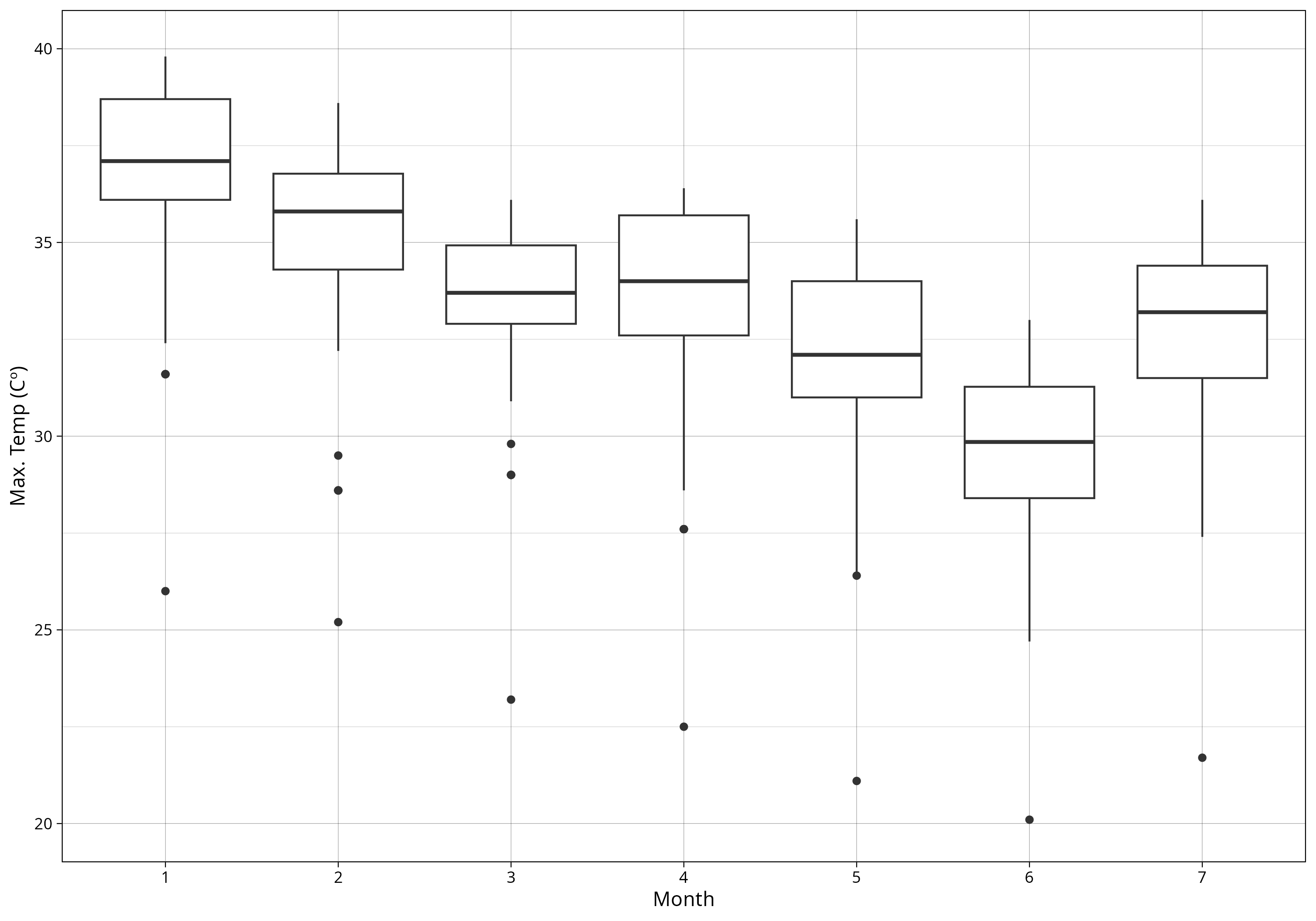
temp_rj |>
  ggplot(aes(x = as.character(mes), y = temp_max)) +
  geom_boxplot() +
  theme_linedraw() +
  labs(y = "Max. temp. (°C)", x = "Month")
library(geobr)

mun_24 <- geobr::read_municipality(year = 2024)

mun_rj <- mun_24 |>
  filter(abbrev_state == "RJ") |>
  select(code_muni, geom)

# `temp_rj` already has one row per municipality and month
mun_temp_rj <- mun_rj |>
  left_join(
    temp_rj,
    by = c("code_muni" = "code_ibge7")
  )

mun_temp_rj$mes <- factor(
  mun_temp_rj$mes,
  levels = 1:12,
  labels = month.name
)

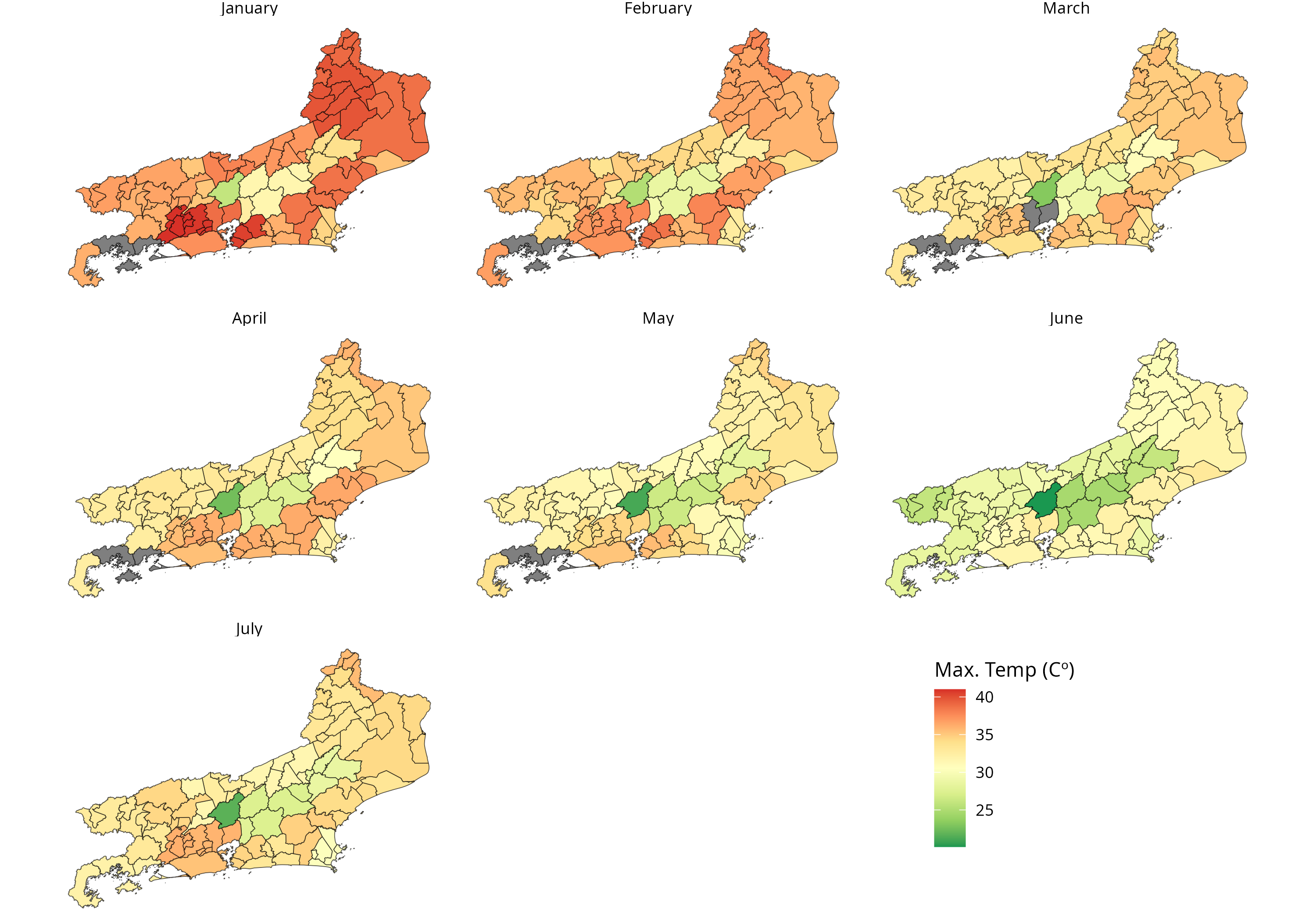
ggplot() +
  geom_sf(data = mun_temp_rj, aes(fill = temp_max)) +
  scale_fill_distiller(palette = "RdYlGn") +
  facet_wrap(.~mes) +
  labs(fill = "Max. temp. (°C)") +
  theme_void() +
  theme(
    legend.position = c(0.785, 0.185),
    plot.background = element_rect(fill = "white")
  )
Citation
To cite package ‘climateBR’ in publications use:
- Bárbara K (2026). climateBR: Download Rainfall, Temperature, and Wind Data from Brazil. R package version 0.2.5, https://CRAN.R-project.org/package=climateBR.
@Manual{,
  title = {climateBR: Download Rainfall, Temperature, and Wind Data from Brazil},
  author = {Kaio Bárbara},
  year = {2026},
  note = {R package version 0.2.5},
  url = {https://CRAN.R-project.org/package=climateBR},
}